

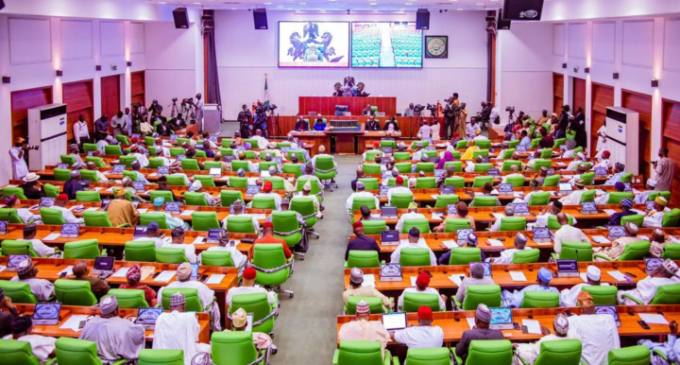
Members of the Joint National Assembly Conference Committee are expected to meet on Monday to reconcile differences in the Electoral Amendment Bill passed separately by the Senate and the House of Representatives, in a move aimed at transmitting a harmonised version to President Bola Tinubu for assent.
Sources within the National Assembly disclosed that the panel has been given a one-week window to resolve contentious provisions in the bill, particularly those relating to the electronic transmission of election results.
The harmonisation follows the passage of differing versions by both chambers, especially on the role of technology in result collation and transmission. Under legislative procedure, a conference committee is constituted whenever the Senate and the House approve varying versions of the same bill.
The amendment process comes amid lingering controversies from the 2023 general election, including the failure of the Independent National Electoral Commission to upload presidential election results to its Result Viewing Portal in real time. Civil society groups, opposition parties and some lawmakers have since called for clearer statutory backing for electronic transmission of results ahead of the 2027 polls.
A National Assembly source confirmed the planned meeting, stating simply that the harmonisation exercise would commence on Monday. Senator Seriake Dickson, who represents Bayelsa West, also indicated that Monday remained the likely date, although he is not a member of the conference committee.
Efforts to obtain official confirmation from Senate spokesman Yemi Adaramodu and the Chairman of the Senate Committee on Judiciary, Human Rights and Legal Matters, Niyi Adegbonmire, were unsuccessful.
A source familiar with the process said Senator Simon Lalong had earlier confirmed Monday, February 16, as the date to reconcile the bill ahead of transmission for presidential assent. House spokesman Akin Rotimi noted that consultations were already ongoing between members of both chambers.
Members of the committee, Sada Soli and Iduma Igariwey, also hinted that the meeting would likely hold on Monday, although they said it had yet to be formally confirmed.
The outcome of the meeting is expected to determine the final shape of the amended Electoral Act and signal the legislature’s position on the role of technology in safeguarding electoral credibility.
The House version of the bill approved real-time transmission of election results, mandating the electronic transfer of results from each polling unit to the INEC Result Viewing Portal simultaneously with physical collation.
The Senate version, however, provides that electronic transmission should occur after the completion and signing of Form EC8A, with manual transmission permitted as a fallback where technological failure occurs. The Senate has insisted that real-time transmission does not amount to electronic voting.
Speaking on a television programme, Senator Adegbonmire explained that INEC currently lacks the capacity for electronic voting, clarifying that the Result Viewing Portal is designed only to publicise results already counted manually at polling units.
Meanwhile, the House introduced additional amendments, including a requirement that candidates seeking to withdraw from elections must submit a sworn affidavit alongside written notice to their political parties not later than 90 days before the poll. The House also proposed reducing the time for tribunals to deliver judgment from 180 days to 150 days after the filing of petitions.
A former President of the Nigerian Bar Association, Dr Olisa Agbakoba, urged the National Assembly to mandate real-time electronic transmission of election results, arguing that it would strengthen transparency and credibility.
He said repeated amendments to the Electoral Act had failed to address fundamental defects in Nigeria’s electoral framework, warning that legal uncertainty continued to undermine democratic outcomes and shift the burden of determining election winners to the courts.
Agbakoba maintained that explicit statutory backing for electronic transmission was necessary, noting that the Supreme Court had ruled the Result Viewing Portal lacked legal force because it was not expressly provided for in the Electoral Act 2022.
He warned that the absence of clear legal provisions had imposed a heavy evidentiary burden on election petitioners and contributed to persistent disputes after elections.
Senate President Godswill Akpabio had earlier indicated that the harmonised bill would be transmitted to the President before the end of the month, raising expectations that the amendments could be concluded well ahead of preparations for the 2027 general election.